Slide 1 Code Start -->

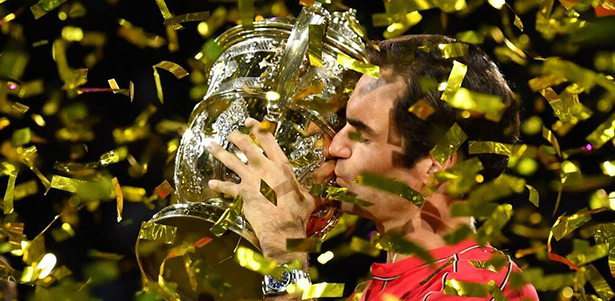
Federer wins 10th Basel title

Roger Federer won his 10th Swiss Indoors Basel title, defeating Alex De Minaur 6-2, 6-2 to secure what the Swiss legend described as "an unbelievable" success at the home-town tournament.

Slide 2 Code Start -->

Federer to play 2020 Tokyo Olympics

Roger Federer will go for gold in 2020. The Swiss star confirmed that he will compete for Switzerland at the 2020 Olympic Games in Tokyo.

Slide 3 Code Start -->

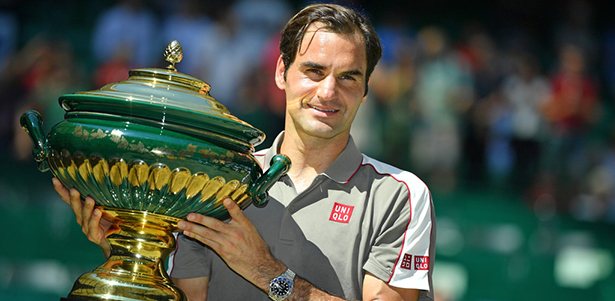
Federer wins 10th Halle title

Roger Federer made history in Halle, defeating David Goffin 7-6 (2), 6-1 to win a record 10th Noventi Open title. It is the first time that Federer has earned 10 crowns at one tournament.

Slide 4 Code Start -->

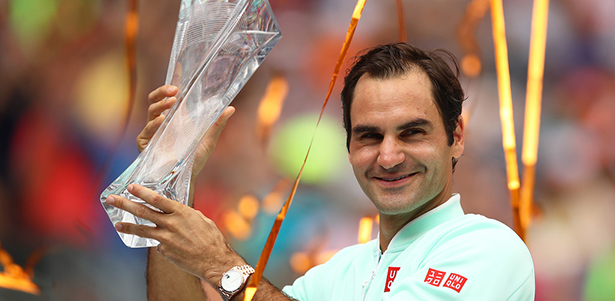
Federer wins fourth Miami Open title

Roger Federer produced a championship masterclass under the Florida sun, dominating reigning champ John Isner 6-1, 6-4 to win his fourth Miami title.

Slide 5 Code Start -->

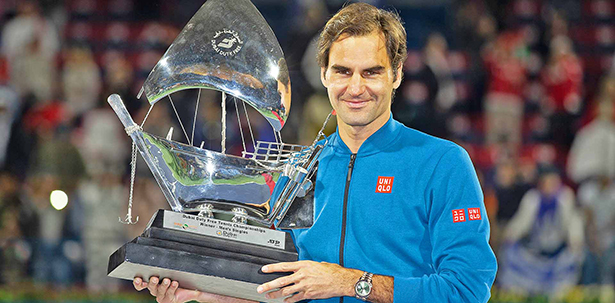
Federer makes history in Dubai, wins 100th title

Roger Federer made history at the Dubai Duty Free Championships, defeating reigning Next Gen ATP Finals champion Stefanos Tsitsipas 6-4, 6-4 to win his 100th tour-level title.

Showing posts with label Deuce. Show all posts

Roger Federer: Fearless At 30

Roger Federer is now 30 years old – typically the tipping point year for a professional tennis player. But dare call Federer "typical" at your own peril.

December in Dubai
               The coach issued a suggestion: try this drill.   
               Now let's try that one.
               Here's one that ends the point sooner.
               How 'bout this one that makes the point last longer?
               This time you get to hit only one serve.
               Come in on the return. 
               Stay back on the return.

The coach was Paul Annacone. More than 30 years into his tennis life, Annacone had honed his game at fledgling Nick Bollettieri Tennis Academy, reached a career-high No. 13 in the South African Airways ATP Rankings, played Davis Cup and gone on to coach Pete Sampras.

So here was Annacone on a December afternoon in Dubai, putting yet another player through the paces, looking for ways during tennis' short off-season to enhance his charge's tools.

And the player was incredibly happy, eager to soak up every one of Annacone's words.

"Roger has the enthusiasm of a 20 year old."

That he happened to be Roger Federer hardly mattered. What Federer does in Dubai has long intrigued. Away from tournaments and rivals, fans and cameras, surely this spot in the Arabian desert is the place where the secrets are stashed; where the genius that has triggered swooning in everyone from literati, like the late author David Foster Wallace, to glitterati, such as Vogue editor Anna Wintour, to zillions of tennis aficionados, is concocted in an elaborate laboratory.

But the recipe was marked by utter transparency. Here Federer was, age 30 – the tipping point year in the life of a professional tennis player – spending anywhere from two to four hours a day hitting ball after ball under the eyes of Annacone and Severin Luthi. Add to that a few more hours with fitness trainer Pierre Paganini and physiotherapist Stephane Vivier. The picture emerged of a man simply conducting business. As another all-time great graced with genius, Rod Laver, recently said, "There's really no substitute for hard work, for putting in all that practice and time."

"I love this game more than anybody, so I'm not all of sudden going to wake up in the morning and say I don't like it anymore," says Federer. "It's a lot of sacrifice. It's a lot of effort I have to put in every day."

But in this case, Federer might be mistaken. Based on the pleasure he took in Dubai, it would be inaccurate to call something Federer enjoys so much a sacrifice. Says Annacone, "For Pete there was more wear and tear by this stage. Roger has the enthusiasm of a 20 year old. There is no need to motivate him. He's relentlessly studious about trying to improve."

If more memorable chapters emerge in the Federer saga, mark 10 September, 2011 as a good day for his prominent last phase to commence. That day there had been a brilliant US Open semi-final versus Novak Djokovic. Despite holding two match points against the Serb, for the second year in a row in New York, Federer had come up empty. His 2011, became the first year since 2002 he’d failed to win a Grand Slam singles title.

There followed a press conference where Federer described Djokovic's dazzling forehand return winner at match point down as "the lucky shot". A backhanded compliment that did not do justice to the victor. Dare a man who has struck as many breathtaking winners as Federer reduce himself by speaking this way of a rival's good fortune?

Later that afternoon, a trip to the ground – that is, Federer is on the floor of the US Open's day care center, playing with two-year-old daughters Charlene and Myla.  And as he simmered and frolicked, Federer began to concoct his plan.

With the diamond-cutter's focus practiced by such longstanding World No. 1s as Sampras and Jimmy Connors, Federer has long been meticulous about his competitive schedule. After mid-September, Federer took six weeks off, skipping the ATP World Tour's Asian swing. He emerged incredibly fresh, winning 15 matches in a row to take the titles at the Swiss Indoors Basel, the BNP Paribas Masters in Paris – his 18th ATP World Tour Masters 1000 crown – and, for a record sixth time, the season-ending Barclays ATP World Tour finals.

"I've always been an emotional tennis player."

The London run was highlighted by a comprehensive 6-3, 6-0 dismantling of Nadal and two sparkling three-set victories over the man who'd beaten Federer at Wimbledon, Jo-Wilfried Tsonga. Said Federer after the final, "For me it was important to step and sort of have that bird's view from up top and say, 'Where am I right now in my year?' It's been a good year. I know I've been playing well, I've been healthy. When is all this hard work going to pay off?"

Having worked with Andre Agassi into his 30s, ESPN analyst Brad Gilbert is quite familiar with the evolution of an aging champion. "Last year I was selling Roger's stock a little bit," says Gilbert. "But what he showed me late last year, I'm buying. That was as aggressive as I've ever seen him."

Like all of us, Federer marches to his own seemingly contradictory yin-yang. What's less frequently seen, but quite important to Federer, is the line that goes from his head to his heart, the deep-rooted passion that has publicly revealed itself only occasionally – such as at the 2006 Australian Open when Federer accepted the champion's trophy from Laver, or at the same spot three years ago following a loss to Nadal.

But as Federer points out, don't think all those fluid shots are issued from an automaton. "I've always been an emotional tennis player," he says. "I used to be so emotional when I used to lose. But I try to keep my emotions in check while the tournament is going on because I like to save it in case there is something more. It can't be an emotional rollercoaster throughout the whole career, season, or match."

"He never gets hurt, he’s sharp, he doesn't overplay."

Paired with Federer's subdued but present emotions is a remarkable tranquility. Watch Federer around a tournament, and you will see a man consummately at ease, never rushed no matter if about to conduct a series of interviews in various languages, in a line for food, killing time in the locker room, on his way to practice, or for that matter, about to pull out a new racquet deep into a match. Says Annacone, "It's like he's at a cocktail party. He's just enjoying every part of the tournament."

And so, as he has so often with his racquet, Federer has his own distinct ability to manage time on his terms. Week after week, he conducts himself with constancy, precision and reliability. Says Gilbert, "He never gets hurt, he's sharp, he doesn't overplay. You see him play a tough match and he’s right out there the next day."

"I'm shocked every time that I've reached so many finals or won against so many players or whatever record it is," says Federer. "It strikes me and makes me obviously very happy and very proud that I've been able to do it for so many years at the highest of levels."

It's that sustained level of excellence that has always made Federer popular with marketers all around the world. According to Forbes Magazine, Federer is the second-most trusted athletic brand in the world – a testament not just to logos and ad campaigns but to sustained performance. Federer's current endorsement portfolio is tidy but significant, including such tennis brands as Wilson and Nike, as well as Rolex, Lindt Chocolate, NetJets, Gillette and others. "It's not just that Roger's arguably the greatest tennis player," says Greg Via, global director of sports marketing for Gillette/P&G who has been part of advertising shoots with Federer in such wide-ranging places as Barcelona, Dubai, Orlando and Shanghai, "but that he stands for something even bigger - a grooming icon, a man who looks good, a man who conducts himself with class and works with us in any number of ways." In Shanghai, for example, Federer went on-stage to teach 1,000 young men how to shave.

The last time Federer entered a year without a Slam title, Barack Obama was a state senator. Like the President of the United States, Federer enters 2012 eager to prove a point. Three major chances for Federer take place in London – Wimbledon, the Barclays ATP World Tour finals and the summer Olympics that this year take place at the All England Club. The Olympics have often been a wellspring for Federer. At the 2000 Sydney games he commenced his romance with a touring pro named Miroslava "Mirka" Vavrinec. Eight years later, taking the Olympic gold medal in doubles with countryman Stanislas Wawrinka helped propel Federer to his fifth US Open singles title.

Even beyond the Olympics, Federer is poised to make his share of major runs in 2012. After all, can Djokovic – quite tired by the end of 2011 – compose another year-long masterpiece? How well will Nadal's body carry him anywhere but clay? Others such as Andy Murray and Tsonga remain more intermittent nuisance to Federer than sustainable rival.

So what are keys to capturing big titles well into one's 30s? While a world-weary Sampras was able to eke out one last run at age 31 when he won the 2002 US Open, such former World No. 1s as Ivan Lendl, Boris Becker, Stefan Edberg and John McEnroe were unable to find the winner's circle past 30. Even after the great Laver swept all four Slams at age 31, he never made it to another major semi-final.

Then there were those who succeeded significantly at this stage – Connors and Agassi with two Slams apiece past 30, Ken Rosewall with four. Study this trio closely, and you will see that Federer shares much: superb footwork, driven by incredibly-alert eyes that send the feet into ballerina-like motion. Tempting as it is to call this a gift – which it might well be – it also clearly a skill, one Federer continues to hone year after year, month after month, day after day, hour after hour, minute to minute.

Over the remaining years of his career, Federer will listen and read to all sorts of conjecture and commentary. There will come losses, at once sobering, at once frustrating, certainly those that signal a possible curtain call. But it's likely the words he'll respond to most will be two that come from Annacone: try this. Knowing that all he can do is control the process, Federer in 2012 figures to do all he can to generate more memorable outcomes.

Date: 13.01.2012, Source: ATP

Roger Federer: The Renaissance Man

Defending Barclays ATP World Tour Finals champion Roger Federer often makes success look easy, embracing and excelling in his roles as player, family man, philanthropist, ambassador and global celebrity.

Earlier this year a major poll was carried out to discover which global celebrities were most respected, admired and trusted. Unsurprisingly, it was Nelson Mandela who topped the list. But guess who was in second place? It wasn’t anyone from politics, culture or business. No, number two on the planet-wide poll carried out by an organisation called the Reputation Institute was none other than Roger Federer.

It’s a lofty accolade, even by this Swiss champion’s standards. Ahead of Bill Gates in third place, Roger was the only sportsperson in the top 15, finishing comfortably ahead of baseball legend Derek Jeter, basketballer LeBron James and football star David Beckham.

One of the rare bits of criticism that tends to come Roger’s way is that he can be a little too concerned with his image. But when you have a halo burning as brightly as his, it’s understandable you would wish to protect and enhance it.

Roger is a global figure in a global sport and, for well-documented reasons, his reputation now stands well ahead that of Tiger Woods, to whom he is now rarely compared. The combination of supreme athletic ability, an astonishing record, worldliness, good deeds, a willingness to show emotion and an easy, metrosexual charm all makes for an irresistible combination.

“When you have a halo burning as brightly as his, it’s understandable you would wish to protect and enhance it”

Roger turned 30 in August and, although he will not hear a word of it, the reality is that he won’t be at the top of the sport forever. There’s no doubting that one reason why the Barclays ATP World Tour Finals has drawn such huge crowds to The O2 is that all self-respecting sports fans want to be able to say that they saw the Swiss master play in the flesh.

And for those who have seen him, what will they remember as his greatest attribute? It could be those technically perfect groundstrokes delivered with a God-given sense of timing. Or maybe the ease with which he glides across the court. In an age when tennis has become such a physically demanding sport, perhaps it is his ability to dominate opponents with such extraordinary regularity over a long period.

Roger made his Grand Slam debut in 1999 at Roland Garros as a then somewhat irascible teenager against Australian Pat Rafter, losing in four sets. As we now know, it was to be the start of an incredible career in the sport’s four major tournaments which, for sheer consistency, may never be matched. Just over five years later he won his second Wimbledon singles title, heralding the start of what, for many observers, is the most remarkable sequence the sport has ever seen.

Amid the mountain of statistics you could apply to Roger, arguably the single most impressive is that between 2004 and Roland Garros of 2009 he reached the semi-finals or further of every Grand Slam. A similar run continues to this day in that he has now made the quarter-finals or further in the last 30 Grand Slams held.

It is all for debate, for there are so many milestones from which you could choose. Another is the fact that he has won the ATP’s year-end championship five times in all, including last year’s victory over Rafael Nadal.

He has also so often made success look so easy, both on and off the court. Many is the time when, in some pressured hothouse around the world, you have seen Roger’s opponent caked in sweat, on his last legs, while the man himself looks to be fresh as a daisy, such is his glorious economy of movement. It is this latter quality which has kept him so consistently out on the tour when rivals’ bodies have succumbed to the physical pressures.

“He appears just as comfortable sitting by the catwalk as he does chatting to impoverished children”

Another crucial factor is that Roger simply loves playing and living on the tour. At the same time he is a man of varied interests who has never been blind to life outside the rectangle of the tennis court.

The son of a Swiss pharmaceuticals manager and South African mother, he has now embarked on raising a family himself, and is the proud parent of twin daughters with wife Mirka, a former professional player herself. Many tennis players have found juggling the ATP World Tour with family life a difficult task, but Roger has embraced it and declared that it has made the whole experience better than ever.

The Federers have always tried to enjoy the places they visit and have made some high-profile friends along the way. Look at Vogue magazine editor Anna Wintour, for example, a regular guest in the player’s box. The 16-time Grand Slam champion enjoys the glamour of the fashion world, yet does not forget the opposite end of human existence, financing schemes to help the poor in Africa through his charitable foundation. It is not unknown for him to travel straight from Milan fashion week to east Africa to personally oversee projects which have benefitted from his organisation. Seamlessly, he appears just as comfortable sitting by the catwalk as he does chatting to impoverished children.

In a similar vein, it is not unusual to see him switching effortlessly from one language to another in interviews. He speaks four tongues fluently.

Roger generally keeps his ferociously competitive instinct well hidden unless it’s on the court, although there is no question that he hates losing, and has a tendency to see each defeat as an injustice. Yet nobody could have achieved what he has done without a burning desire to win. There is no obvious sign of that desire waning. When it inevitably does, however, he has little to fear from the tennis afterlife; probably less than most players. Such are the capabilities of his mind and the range of his interests, it may even appear to him that, when he has more time on his hands, life will only just have begun.

Date: 18.11.2011, Source: ATP DEUCE

Roger Federer: The Road Ahead

Roger Federer, now 30, is convinced he can win his 17th major title.
 At 30 years of age, Roger Federer's love for the sport has not dimmed. The great champion is convinced he can lift more major trophies.

At the Gerry Weber Open in Halle, Roger Federer and Peter Lundgren are going at it in the hotel room. What is happening?

“It is about 12:30 and he is going on at 1 p.m.,” remembers Lundgren. “I am telling him that we need to go and warm up for the match against Patrick Rafter and he says, ‘No I don’t want warm up.’ And I said 'why not?' And he says, ‘Because I don’t want to.’ And I am like, 'we need to warm up before the match, right?’ And he says, ‘Yes, but I want to warm up with you.’  And then he jumps on top of me and we start wrestling. After three or four minutes he jumps off me and says, ‘See, now I am ready.'”

That was 10 years ago, and today Roger Federer is wrestling something a little different - a legacy that is steeped with such high expectations that nothing short of winning every match he plays will satisfy the critics.

That Federer likes a challenge is a good thing, because there is plenty of that to go around these days. As Novak Djokovic tightens his grip on the top spot in tennis, those that know Federer best believe that the Swiss thrives on challenges.

“One of the great things about Roger is his big-picture perspective,” claims Federer’s coach Paul Annacone. “People may not realise just how competitive that the great ones tend to be. Roger’s competitive fire is still at the highest possible level. His steadfast ability to compete over such a long period of time is pretty impressive. Pete (Sampras) was like that.”

Federer’s career could be set to a Shakespearean drama. His rise to prominence on the world’s stage did not come all at once, but rather in acts.

“We could see the potential, but his body was not ready yet,” remembers Lundgren of Federer’s transition from juniors to professional. “His movement and endurance had to be improved. And during the point he had so many tools in the box, so many ways to win. It was like too many choices. He would make it complicated because he could do so many things. Then he beat Sampras (2003 Wimbledon) and it was like a new opening. Still it was a long way to winning a Slam.”

Actually, it was not too long. Two years to be exact.

“Winning Wimbledon changed everything,” says Lundgren.

From 2004 until 2007, Roger Federer started climbing high into thin air. Here are his numbers; 74-6, 81-4, 92-5, and 76-9. Three hundred and twenty three wins out of 347 matches. An incredible 93 per cent win to loss percentage.

“When he had this streak of making every single final, or 20 consecutive Grand Slam championship semi-finals it was shocking,” says former Wimbledon finalist MaliVai Washington. “No one in the history of tennis has done that. Agassi, Sampras, they had great runs and great years, but to reach the finals of 20 consecutive majors is one of those records that will probably never be broken.” (Federer reached 23 successive major semi-finals).

Despite what it may seem at times, Federer is only human after all.

“You know, I think it is always the same for those guys at the very top,” says Annacone. “The expectations are so high, basically, they are pretty unrealistic. I mean to stay in ‘forever’. That is sort of how the media works. It makes for provocative conversation and debate as careers change and other players come on the horizon. That is sort of nature of the beast kind of thing. I think Pete (Sampras) knew how to handle it, he just got tired of it. Everybody gets tired of speculative, negatively connotated questions. This is only human nature. However, Roger’s level of enthusiasm for playing tennis is not that of a normal 30 year old. He loves playing the game. I think his emotional freshness is way different.”

“When you are a player at the top there is so much tension and expectation,” says Washington. “You want to perform well for your family, friends, fans and sponsors and there is just a lot going on around you at every tournament. And each player has to figure out how to perform with that. Roger and Pete have done that as about as well as anyone I have ever seen.”

This must seem a little like Groundhog Day for Federer. It was only a couple of years back that Rafael Nadal yanked the No. 1 South African Airways ATP Ranking from the Swiss star’s grasp and his demise was widely reported. We all know how Federer responded to that challenge. Will Federer ever dominate tennis again the way he did from 2004 to 2007? Most likely no. What is it inside of us that likes to build up and then tear down our sporting idols?

Federer does not grunt and he rarely groans. His sportsmanship and class are what people will remember most. Then there are the little things he does that mean so much to other people around the world.

In the champions' locker room at Wimbledon in June 2010, Federer has just finished a post-match press conference following his semi-final round loss to Tomas Berdych. Obviously, he is gutted. Upon entering the locker room he is handed an express mail letter. The letter reads:

“Dear Mr. Federer,
On behalf of the Tennis Federation of Cambodia, we would like to express our most heartfelt appreciation for the autographed shirt that you sent to us in support of Our Killing Fields To Tennis Courts program. Due to the genocide of the Khmer Rouge thirty-five years ago, life as we knew it in Cambodia stopped. Tennis was no exception. Our determination to be part of other tennis nations and have our kids enjoying the sport is our main objective. Just knowing that you thought of us gives our kids inspiration for the future.
With Great Respect and Appreciation,
Rithivet Tep, Secretary General, Tennis Federation of Cambodia."

Whether he wins or loses, Roger Federer is in demand. And all you need to do is sit through a few of his press conferences to observe how politely he answers each and every question.

“It is difficult to give you a number of requests per tournament, there are so many, but it is safe to say that Federer spends at least 30 minutes with the press after each match he plays, often close to one hour,” reports Nicola Arzani, ATP Senior Vice President, PR & Marketing. “I am sure there is no other sportsman in the world who is doing as much as him. Obviously the three languages keep him longer.”

“In so many ways, Roger Federer has honoured the game,” claims coach Chuck Kriese. “And in return the game has honoured him.”

Roger knows that wherever he goes and whatever he does everyone is watching. Even the players and coaches on the ATP World Tour keep tabs on each of his matches. And the locker room talk is not about his 16 Grand Slams so much as what shot he hit in practice or which match was special.

If Federer were a painter his Mona Lisa would be the match he played in the Tennis Masters Cup final at Shanghai in 2007 versus David Ferrer. It was a near perfect match.

“That match was the one of the best if not the best I have ever seen,” says one long-time veteran coach who prefers to remain anonymous. “That match just might have changed the way players play the game in regards to court positioning."

“I remember the match very well. It was one of the best matches I have ever played,” Federer tells DEUCE. “It was at the end of the season, and to crown it when I had already had a wonderful season was really nice. I was able to hit backhands down the line whenever I wanted and move almost like I was gliding around the court. It was one of the great matches.

“I hope I played some part in inspiring this generation or the one coming up now,” continues Federer. “Pete kind of started hitting huge second serves, and people did not think it was possible to hit 110 or 120 miles per hour second serves. And then Goran [Ivanisevic], [Richard] Krajicek, [Marc] Rosset and [Mark] Philippoussis started doing it. I hope that I was able to create something else as well. What, I don’t know. That is up to others to judge.”

Just last year at the BNP Paribas Masters in Paris-Bercy, Federer went to the canvas once more, granting all those present a brief glimpse of greatness in his match versus Jurgen Melzer. In less than 19 minutes, Federer was up five games to love.

“Sometimes when he gets going he is on another level of tennis,” says Joakim Nystrom, Melzer’s coach. “But that first set at Bercy, he was in another stratosphere.”

Federer tells DEUCE, “You are always trying to prove to yourself that you can be the best tennis player you can be. I learned a lot since I started the game more seriously at the age of 14. The last 15 years have been an eye opener in every way of life. It has been fun being a part of the dream that I created of becoming a tennis player.”

The parity in men’s tennis has never been stronger, still, only a handful of tennis players have won Grand Slams in the past eight years. What does Federer think about that?

“I have my doubts sometimes what guys outside the Top 50 do with their schedules,” says Federer. “I feel like sometimes it is important to prepare their schedule in such a way that they peak at the right tournaments. If you look around at the top players they know when they want to peak. And it does not always have to be a Grand Slam, it can be something personal like their hometown tournament. I sometimes miss that in the lower-ranked players. I don’t think that they take enough weeks off. Because they feel that next week is the breakthrough week. Something is going happen.

"I know it is tricky for some because you've got to play when you get in, and I know that, but I am a big believer that you need to take breaks for recuperation, going on vacation, going away and putting the racquet in the closet and just lying on the beach trying to get inspired for when you come back and practise extremely hard when you come back. Then you can really play. Fortunately, or unfortunately, the tour is from January to November, so you can either always play or you can take rest and you can still play again. I think that, in the big scheme of things, that might be a bit of a twisted situation for many coaches and players at that level.”

For Federer, he has repeatedly said that he continues to enjoy playing as much now as ever.

“What I find most amazing is that at this stage of his career he loves the game so much,” says Annacone. “And to me that is paramount and when you enjoy the game so much it makes it easier to play. Roger is very, very clear and robust in his approach to tennis. He is very fresh and energetic.”

“If you asked Roger if he feels like he can win majors he would say 'yes',” suggests Washington. “He was in the final of Roland Garros this year. Yes, he has gotten older, but I think he is every bit as good as he was a couple of years ago.”

Sow does Federer handle disappointments?

“I think one of the great things for guys like Roger, or great athletes who maintain a high level for a long period of time, is that they generally maintain a healthy perspective and Pete was great like this,” says Annacone. “They are very secure in who they are as players and people and I don’t want to say that it makes it easier to accept, but it does make it easier to comprehend.”

“My attitude has changed a lot towards the matches as the years have gone by,” says Federer. “The love for the game has always been there. I would not change it for the world and I would do it all over again; I am very happy where I am at right now. I do take losses a bit easier, but that does not mean I did not try my best. What is nice about tennis is that you can play qualifying and can have the opportunity of winning the tournament even though it is tough, you do have a chance to win a tournament. The dream always looms.”

For the fans of Federer, the fact that he continues to be a threat at the majors is also a dream. And one that could very well come true soon.

Date: 27.08.2011, Source: ATP DEUCE Magazine

Roger Federer: Defining Swiss success

Four titles, including a Grand Slam crown, might enough for most players in one season, but Roger Federer isn't really like most players...

Roger Federer agrees with former tennis great Pete Sampras, who once said: “Every year with a Grand Slam title is a great year.” From this point of view, his season already was a huge success after the first major tournament.

Federer started 2010 by winning his 16th Grand Slam title at the Australian Open, beating Andy Murray in the final and increasing his lead over former record holder Sampras, who finished his career with 14 of these trophies. “In Melbourne, I played some of the best tennis of my life,” Federer says, looking back.

But after being thrown back by a lung infection in February that kept him from playing in Dubai, Federer went through some tough times. He surrendered his titles at Roland Garros and Wimbledon, losing in the quarter-finals to hard-hitting Swede Robin Soderling on a wet and cool day in Paris and to Tomas Berdych in Wimbledon, thus missing the final of the All England Club Championships for the first time since 2002.

The defeat in Roland Garros ended one of the most astonishing streaks in tennis history. Federer had reached at least the semi-finals in all of his past 23 Grand Slam tournaments. The loss had another consequence: Federer lost the No. 1 spot to Rafael Nadal and missed the chance to surpass Pete Sampras, who holds the record of most weeks at No. 1. His total now stands at 285 weeks, only one week short of the record.

“Rafa fully deserves to be No. 1, since he won the last three major tournaments,” Federer says. “But I know if I am playing well, there is no question that I am able to challenge him and get a chance to return to the top spot.”

In August, Federer managed to conquer the Western & Southern Financial Group Masters in Cincinnati for the fourth time. It was his 17th ATP World Tour Masters 1000 title, equalling Andre Agassi and putting him only one win behind leader Rafael Nadal.

But luck was not on Federer’s side at the other three big U.S. tournaments. At each of them he lost after having wasted match points, in Indian Wells against Marcos Baghdatis, in Miami against Berdych and in a spectacular US Open semi-final against Novak Djokovic.

But Federer still finds a lot of positive aspects in his 12th full season on the ATP World Tour. In Paul Annacone, a former pro and long-time-coach of Pete Sampras, he found a new, highly experienced coach to strengthen his team and add new ingredients to his game and tactics. Having spent some years on the tour without a coach, Federer now counts on two of them, Annacone and his Swiss friend Severin Luthi. He also managed to play through the whole summer without being hammered by injuries or back problems.

He again paused for four weeks after the US Open to recharge his batteries in Dubai, his second home, and to stay with his wife, Mirka, and his twin girls, Myla Rose and Charlene Riva. They started to keep him busy by running around in all directions. “I always try to guess where they are going, but every time I am wrong,” he laughs.

When Federer returned to the tour in Shanghai, he felt fresh and eager to play in a way he’d rarely felt before at this stage of the season. In China, he avenged his loss to Djokovic and went on to reach the final, losing to Andy Murray.

Only one week later he conquered his third trophy of the year, winning the If Stockholm Open for the first time. With his 64th title overall, he equalled the career total of Pete Sampras. The following week, he surpassed Sampras’s mark by winning his hometown title at the Swiss Indoors Basel. Only three players have won more tournaments in the Open Era – Jimmy Connors, Ivan Lendl and John McEnroe.

“Compared to my best years, 2010 was not that great,” Federer acknowledges. “It could have been better, but it could have been much worse. All except one player would be happy to get these results.” He was looking forward to the great finale of the year, the Barclays ATP World Tour Finals in London. “I am very optimistic that I can end the season on a high note.”

The View From Switzerland:

When Roger Federer arrived at the Swiss Indoors in his former hometown Basel for the 11th time in early November, 9,000 fans awaited him and gave him a standing ovation before his first match. Federer is in a class of his own when it comes to popularity in Switzerland.

He was the first living person to appear on a Swiss stamp. In 2003, the Swiss TV-viewing public gave him the most important award of the country, “The Swiss of the Year”, when he only had one Grand Slam title under his belt.

Federer is the most popular and respected person in his home country and has attracted new people from all ages and classes to tennis. Most realise that he is the best and most important ambassador for the country, which he represents with values that count as typically Swiss: reliability, quality, humanity.

Some criticise him for his reluctance to play every Davis Cup tie, but he keeps promising that one day he will do everything to win this trophy for the first time for Switzerland.

Date: 19.11.2010, Source: ATP Deuce